Don't have too much time to write out a large blog entry, but I thought I would mention that I put up a few more photos on photobucket. These are the main members of my close family (my homestay mother and father and four younger sisters), but there are plenty more important people to come!
http://s1197.photobucket.com/albums/aa428/katierichards0/Training%20Homestay%20Family/
Other than that, tomorrow is the date that we "swear-in" and become official Peace Corps Volunteers! It is very exciting to have successfully finished this two month rigorous training, but its going to be tough to leave the family I have grown to love here. Luckily, after swearing in, we will spend one more day with our families, the holiday of Tabaski. Tabaski is a muslim holiday, primarily marked by the fact that every family will slaughter a male sheep (kind of a more gruesome version of Thanksgiving). Everyone here raves about this holiday, so it should be a good cultural experience...
And after that, on November 11 at exactly 6:00 pm (though lets be honest this timing does not exist in Africa), I will be kicked out of Peace Corps car with all of my baggage to move into my future hut...should be intense, so if any of you feel the need to write a supportive email, I would be very receptive..haha...
till next time.
Thursday, November 3, 2011

Sunday, October 16, 2011
A few pics...
Just to show you what my homestay is like, sorry the internet connection is a bit slow to add too many more...

My Room!

The courtyard of our compound and the much
needed shade tree!
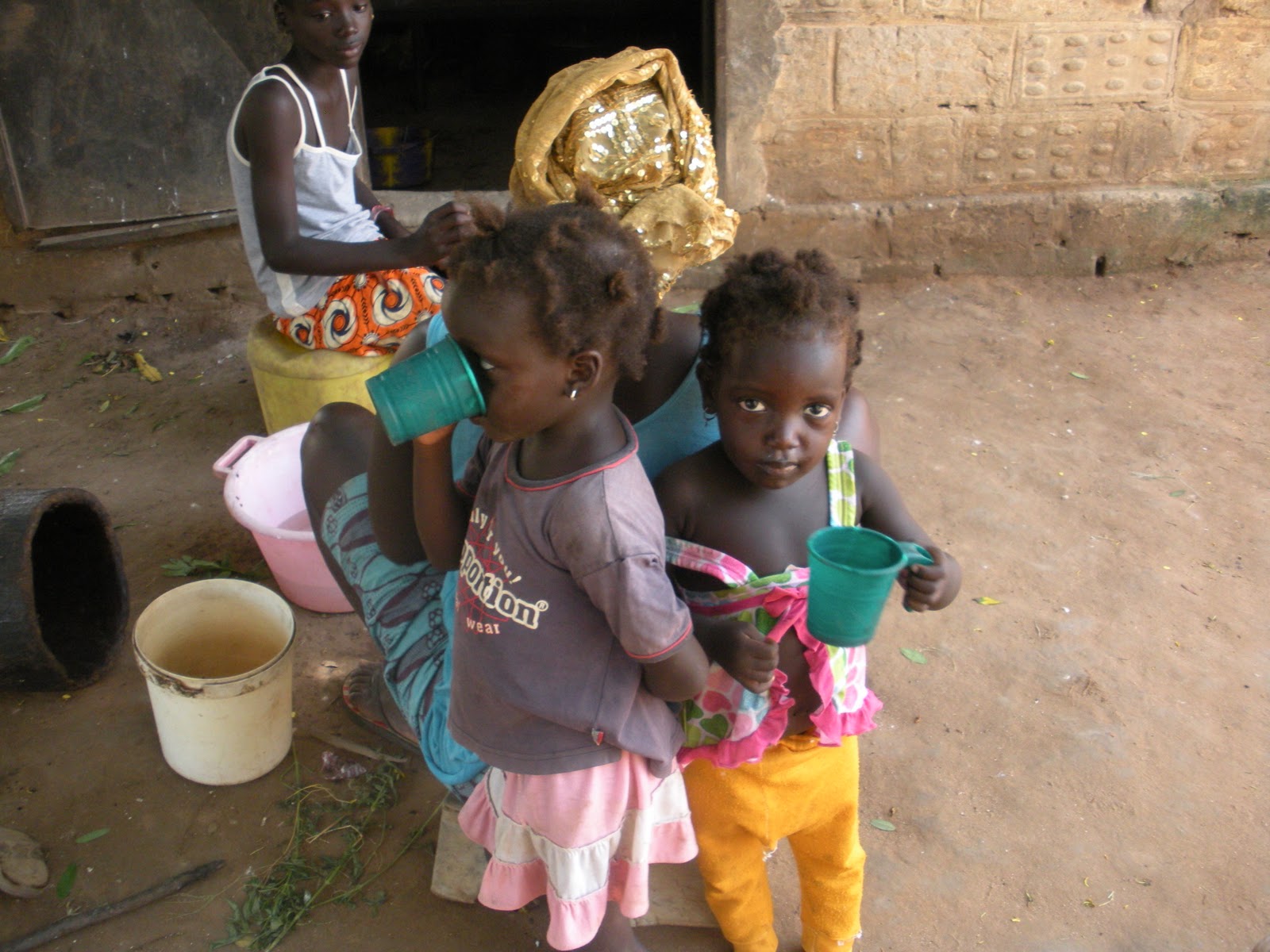
My two younger sisters, Anta and Marem, drinking a cup of
joe (seriously) in the morning. The one to the right is my namesake.

The women cooking for the naming ceremony.

Ismillah, the now five month old baby that
I am adopting...

My house! Three families live here with now
14 kids among them... its a hopping place in the daytime
New Additions!
Wow, just had quite an eventful week back at my homestay! The rains have now stopped in the Thies region of Senegal and the weather has turned hot and windy…soon the long awaited cool season should arrive (though I’m starting to believe this cool season may be a myth). Due to the change in weather, upon arrival in my homestay this past Sunday, I opened my room to be pleasantly greeted by moving walls and windows. According to my homestay mother, the end of the rainy season brings hoards of small beetles that hatch out of the specific species of tree within our family compound. During the nighttime these beetles venture out of this tree and into nearby enclosures…aka my room and the shower. Not to worry, my aunt and father did a wonderful job of sweeping out buckets and buckets of them and chucking them outside. Every night a few hundred seem to return, but my bed is tightly wrapped in a mosquito net so that I can sleep soundly.
In addition to welcoming new bugs into the family compound, my aunt has just welcomed a new baby girl! The Thursday before my arrival, my aunt went to the hospital to have her baby. After the birth, here in Senegal, the baby is kept fairly secretively in a room for 24 hours a day for one week. Only women are allowed to come visit and give small gifts like soap, but this is all a very private event. Also, during this week, the baby is not named. On the seventh day, everyone gathers to hold a gigantic naming ceremony, known here as an “ngeente.” Thus, this past Thursday, the other three trainees and I got a chance to experience a traditional naming ceremony.
The day before the naming ceremony, the father of the new baby went into the city of Thies to buy a live male sheep (which costs approximately $100). The sheep was kept in the courtyard for the night, happily alerting me of its presence hourly. The morning of the ceremony was very hectic…all the women of my household were busied with cleaning up the compound for the impending crowd. At about ten in the morning, people started streaming in. Mats were laid out on the ground for men and children but most women/girls over the age of 5 were still working by bringing bowls and plastic chairs from nearby compounds and beginning the cooking process. The women did not partake in much of the actual ceremony portion as they were in charge of cooking. The ceremony itself was very short, though slightly traumatizing for the toubabs. At about 11, the still unnamed baby finally emerged from the room to be placed in the middle of a circle of old, important men. Just as we were watching this, the live sheep was lead directly behind us. The circle of men said prayers over the baby and, as I was told later, actually announced the name of the baby at this time. As you may imagine, we were all largely distracted by the sheep slaughtering occurring a few feet from us. I refused to partake in the viewing portion of this, but still failed to catch the new name…Say Mbaye. After this, the crowd dispersed and the rest of the day was filled with cooking sheep, rice and onions for everyone in the village. In the evening, a crowd of women dressed up in traditional clothing and came over to give lost of gifts to the new mother (primarily soap, fabric and money). The party quickly dispersed at night fall when the beetles returned.
The day before the naming ceremony, the father of the new baby went into the city of Thies to buy a live male sheep (which costs approximately $100). The sheep was kept in the courtyard for the night, happily alerting me of its presence hourly. The morning of the ceremony was very hectic…all the women of my household were busied with cleaning up the compound for the impending crowd. At about ten in the morning, people started streaming in. Mats were laid out on the ground for men and children but most women/girls over the age of 5 were still working by bringing bowls and plastic chairs from nearby compounds and beginning the cooking process. The women did not partake in much of the actual ceremony portion as they were in charge of cooking. The ceremony itself was very short, though slightly traumatizing for the toubabs. At about 11, the still unnamed baby finally emerged from the room to be placed in the middle of a circle of old, important men. Just as we were watching this, the live sheep was lead directly behind us. The circle of men said prayers over the baby and, as I was told later, actually announced the name of the baby at this time. As you may imagine, we were all largely distracted by the sheep slaughtering occurring a few feet from us. I refused to partake in the viewing portion of this, but still failed to catch the new name…Say Mbaye. After this, the crowd dispersed and the rest of the day was filled with cooking sheep, rice and onions for everyone in the village. In the evening, a crowd of women dressed up in traditional clothing and came over to give lost of gifts to the new mother (primarily soap, fabric and money). The party quickly dispersed at night fall when the beetles returned.
Other than this exciting ceremony, we are all continuing to learn Wolof, which is getting better and better each day. I am in love with my family here and will be extremely sad to leave them in a couple of weeks. I'm working on uploading a ton of family photos but the internet connection is a bit tough...till then!
Thursday, October 6, 2011
Hut Life
Just got back from my "volunteer visit" where I spent a few days learning about hut life! I don't have too many exciting updates since my last post, however, I did get to ride in some interesting transportation. To get to the remote village (not the one I will be staying in, but by the time you get this rural in Senegal its usually all the same) I rode on what's called a sareet. A sareet is like a horse or donkey drawn carriage, and by carriage, I mean some boards attached to a couple of wheels with the animal tied to the front. I also rode in a couple of buses/seven passenger cars where goat, sheep, cows and chickens are frequently strapped to the top or hanging out in the trunk. I'm sorry to say that I have not captured a picture of this yet, something to look forward to.
I did however take some pictures of what my living situation will probably look like for the next two years. I uploaded these pictures to a public album on photobucket, check it out!! Just as a note, the people in the pictures are members of the homestay family of the volunteer who I visited, I don't really know these people. This will just give you a taste of my environment, enjoy!
http://s1197.photobucket.com/albums/aa428/katierichards0/
Thursday, September 29, 2011
I can't do anything...apparently
Whew! Just finished a couple of weeks at our community based training sites, the longest stint we will spend at these homestays. I have two more weeks in this homestay and then I will be moving to my permanent site!! As of now, I BELIEVE I officially know all the names of the members in my family, approximately 20 in total (though I am still confused onto how some are related). In Senegalese culture, it is completely appropriate to show up unannounced at a friend or family members home and stay for as long as needed (something I may take advantage of in the states with my minimal Peace Corps salary). Thus, there are often multiple people living in my compound who are as distantly related as my grandmother’s sister’s cousin or simply named after someone in the family…
Aside from slowly but surely understanding the family, I am also beginning to understand the language (which I previously believed to be gibberish). Wolof is a tough language! As opposed to conjugating verbs, Wolof conjugates pronouns and the sentence structure is jumbled compared to English. If I wanted to say “I went to Dakar” for example, I would turn it into “to Dakar I went.” This makes for slow communication as I flip everything around before speaking, though on a positive note, allows for a natural filter. As communication gets easier I am also beginning to realize some of things my family says to me. Their favorite new phrase is “menoo dara,” which translates into “you can’t do anything.” This is usually in reference to my great hand washing laundry skills or my inability to cook food over a few flaming sticks.
Other than slowly getting over communication barriers, the homestay was composed of a few intestinal upsets but nothing out of the ordinary. These types of things are unavoidable when sharing lunch and dinner out of a large communal bowl where people of ALL ages eat with their hands. My sickness allowed me to learn that in this culture, when someone is sick, EVERYONE will continuously ask, “are you healed??” It is culturally inappropriate to say no, so of course I always said yes. For about a week, I’m sure my family had no idea whether I was sick or not.
In other, more exciting news, I have found out where I will be spending the next two years!! I will be posted in a small village of approximately 300 hundred people very close to the Gambian border and in between the cities of Koalack and Tambacounda. I am told I have one volunteer relatively close to me, meaning a couple of hours away, and a city with lots of amenities around 15 kilometers away. Thus far, I don’t know all that much about my site aside from the varieties of field crops they farm, which I am sure is not interesting blog information. This Sunday, however, I will be visiting the area to stay with a current volunteer. I will not get a chance to actually stay in the village as I am told it is too far out in ‘dem boonies.’ But I hope to at least see the region and become familiar with my surroundings.
For now, I’m gorging myself on food from the center, showering frequently, perusing the Internet and speaking lots of English. Oh and sorry to say that I still have no pictures, I have had a few technical difficulties. Hopefully I will get some up with the next post (if you cannot wait, check out a few other PC Senegal blogs that I have links to on the side). Until next time!
Tuesday, September 13, 2011
Marem
Hello all! This past week was our first in “community based training” or CBT. I was placed in a very small community not far from the training center with three other volunteers and a Senegalese language teacher. My family is wonderful! Though after the first week and my slim communication skills, I am still getting to know the family structure and daily activities. Thus far, I have figured out that my compound contains three families. The three wives are sisters and all live in separate rooms of the house with their respective husbands and children. My mother (yaay) is named Marem and my father (baay) is Ousman…of this I’m fairly positive, considering they often say their names very quickly! I have at least four younger sisters (although a couple more mysteriously arrived this weekend) and they range in age from 2 to 10. In addition to my mother, the other two wives within the compound have adopted me as their own, showing me the Senegalese way of life. They have 4 and 5 children respectively, so our compound is constantly bustling. The youngest child, Ismilla, is less than a year and I am told I will be taking him to America when I leave… Oh, and to match my family, I was given the new Senegalese name Marem to match my mother. It is frequently shouted at me from all corners of the neighborhood. I much prefer this to kids yelling “tubaab!,” loosely translated as “foreigner.”
Life in the village is extremely busy, overwhelming, hilarious, confusing and embarrassing, but overall it’s getting better and better day-by-day. Each morning the other volunteers and I would work out in a garden established by previous Peace Corps trainees. We practice various techniques (i.e. composting) that we will be implementing/teaching at our permanent sites. After that I usually return home for a much needed bucket shower. The rest of the morning is filled with an intensive language session at the house of our LCF (language and cultural facilitator), in his room, on the floor…pretty informal. There are often goats running/pooping around, children screaming and lots of flies. It makes for an interesting learning environment compared to Whitman. Then it is home for lunch, and back for an afternoon session. At about five o’clock all the “tubaabs” go for a walk to speak some solid English and then return home for dinner. The evenings and early night hours are social and my family often sits out in the courtyard on woven prayer mats drinking a tea known as attaaya (very strong, very sugary, quite a jolt).
Food and eating rituals at my house have been a bit of an adventure. Breakfast is often bread and coffee (a spiced coffee known as “café tuba,” for an American, a bit hard to stomach). Lunch and dinner are eaten out of community bowls, one large bowl placed in the middle of ten or so people (adults and children are USUALLY separate if I'm lucky). Its important to eat only with your right hand, the left hand has other purposes of course… The bowls often have lots and lots of rice or millet, with a few vegetables and some type of meat in the center. This week my family had ceebujen (fish with rice) for just about every meal. The fish is whatever they are able to catch and is never a recognizable species. The one day we did not have fish, I asked my mom’s sister what she was cooking and she replied with “mbutt.” Of course I had no idea what this was so I just nodded along. When the bowl came out, I was still a bit confused and was told that it was similar to chicken (rooster maybe??), though I could not locate any of the meat bits in front of me as thigh or leg etc. Later, the afternoon language class revealed to me that I had just eaten….MONITOR LIZARD…and it did taste like chicken.
Now, I’m here at the training center for a couple of days. We will return to our homestays tomorrow and stay for about 2 weeks. These next two weeks will continue with language training and complete immersion. It only gets easier from here!
Feel free to shoot me an email if you want any more details, oh and I'll try and get some pictures up with my next post! Hope all is well in the western world!
Monday, September 5, 2011
Wolof!
Hi All!
 Just an update, I now have a cell phone! I'd love to chat with people but probably won't have my phone on frequently. Shoot me an email if you'd like to chat and we can set up a time! Or if not, I LOVE EMAIL!
In other news, today I found out that Wolof will be the language spoken at my Peace Corps post (the location of which remains unknown). French is the official language of Senegal, though everyone speaks different local dialects, including Wolof, Pulaar, Mandinka etc. In total, our group of 55 is learning seven different languages!
Tomorrow, we take our language training out of the training center cocoon and into the villages surrounding the city of Thies, known as "community based training" or CBT. I will be placed with 3 other volunteers and one language teacher within the same community. We'll meet everyday to go over more of the language and ask endless cultural questions. Should be pretty exciting! About to take the plunge! My next post will hopefully be in about week and have a lot more interesting information...
The picture, as requested by my mother, is just to give you an idea of what the training center looks like! Its pretty big, lush, with quite a few concrete buildings.
Subscribe to:
Posts (Atom)